
 English
 Russian
 French
 Spanish
 Portuguese
 Korean
 Japanese
 Thai
ThaiEfficiency Unleashed: The Role of Vacuum Homogenizers in Modern Manufacturing
Efficiency isn't a buzzword in manufacturing. It's the difference between survival and obsolescence.
Every second a production line sits idle, every batch that fails QC, every product that separates on the shelf — these aren't minor inconveniences. They're compounding losses that erode margins, delay shipments, and kill competitiveness. In an era where global supply chains demand speed, consistency, and zero waste, manufacturers need equipment that doesn't just keep up — it rewrites the rules of throughput.
The vacuum homogenizer is that equipment.
By collapsing multiple processing steps into a single vessel, eliminating rework, and delivering batch-to-batch consistency that traditional systems can't touch, vacuum homogenizers have become the single most impactful piece of hardware on modern production floors — from cosmetics labs to pharmaceutical plants, from food factories to battery gigafactories.
This is how they do it.
The Efficiency Crisis Nobody Talks About
Before understanding the solution, you need to understand the problem.
Modern manufacturing doesn't fail because of bad products. It fails because of bad processes. Consider a typical cosmetics production line:
Step Equipment Time Failure Rate
Pre-mixing Conventional mixer 15–20 min 8–12% (air entrapment)
Emulsification High-shear mixer 10–15 min 5–8% (inconsistent droplet size)
Deaeration Separate vacuum chamber 10–15 min 10–15% (re-aeration during transfer)
Cooling External jacket 5–10 min 3–5% (temperature overshoot)
CIP Cleaning Manual/semi-auto 30–45 min Variable
Total cycle time: 70–105 minutes per batch.
Now multiply that by 8–12 batches per shift, factor in rework from failed QC, and add the labor cost of transferring product between four different vessels. The inefficiency isn't hidden — it's structural. The process itself is the bottleneck.
And it's not just cosmetics. Pharma lines face the same multi-step trap. Food manufacturers lose entire batches to oxidation. Battery producers struggle with slurry consistency that costs millions in cell failures.
The industry didn't need a better mixer. It needed a better process architecture.
What a Vacuum Homogenizer Actually Does
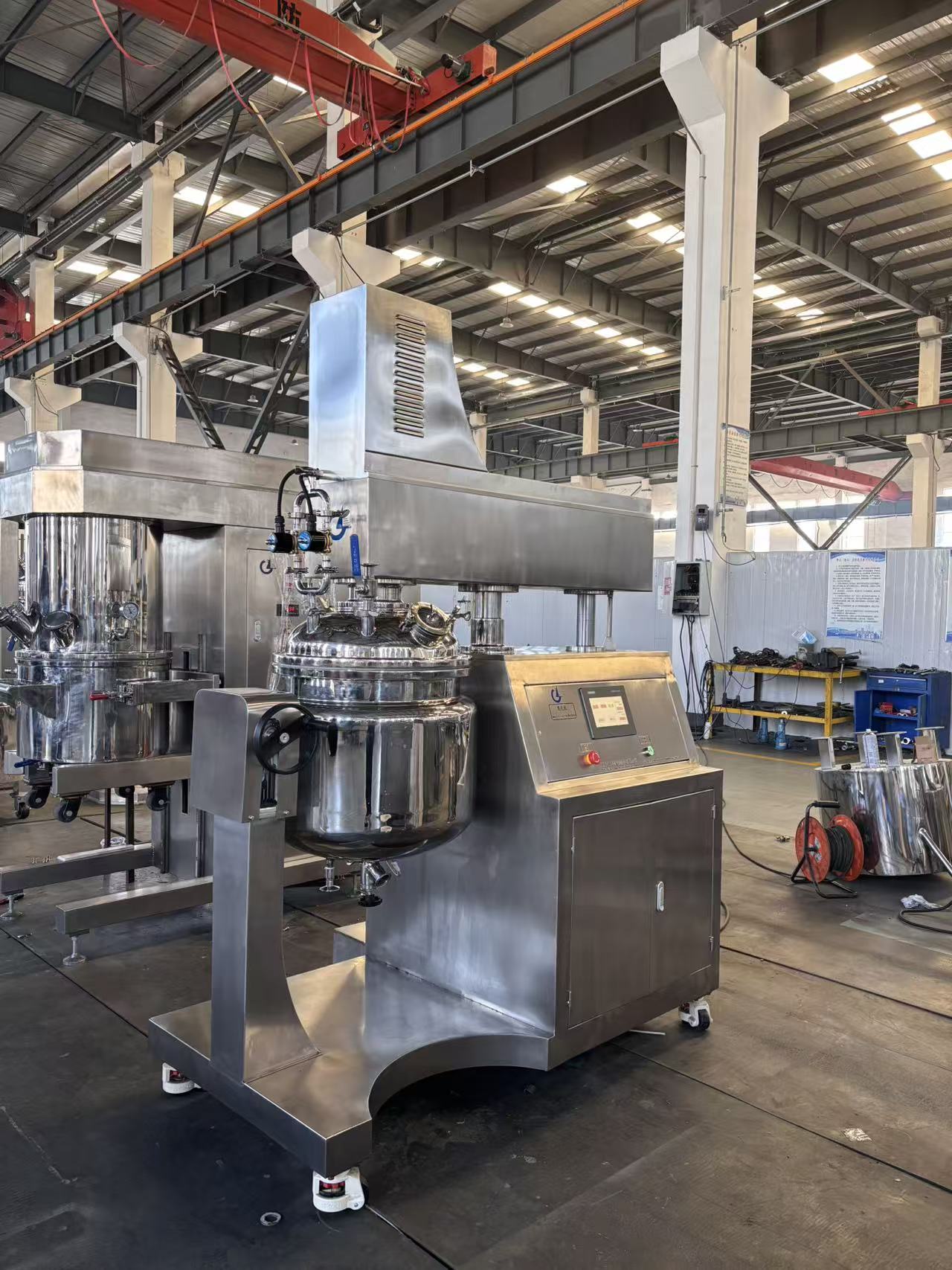
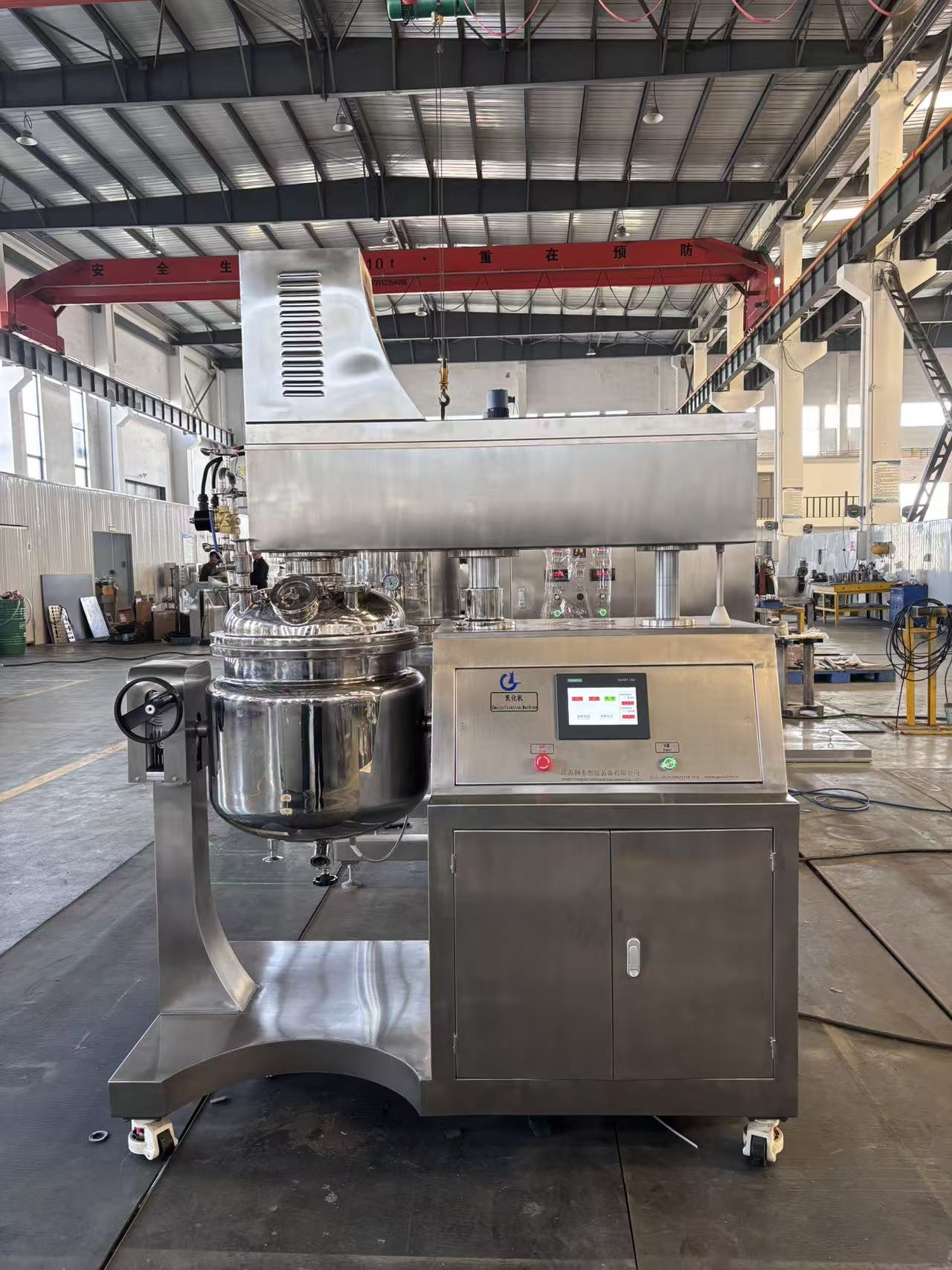
A vacuum homogenizer is not a single-function machine. It's a process consolidation platform — one vessel that replaces four.
Here's what happens inside:
Function Traditional Approach Vacuum Homogenizer
Mixing Separate vessel, 15–20 min In-vessel, 5 min
Emulsification Separate high-shear mixer, 10–15 min Simultaneous with mixing, 3–5 min
Deaeration Separate vacuum chamber, 10–15 min Built-in, real-time, zero transfer
Temperature control External jacket, slow response Integrated jacket, ±2°C precision
Cleaning Manual disassembly, 30–45 min CIP-ready, <15 min
One vessel. One operator. One cycle.
The physics is straightforward:
Vacuum activates first → chamber drops to -0.095 MPa → all air is removed from the bulk phase before mixing even begins.
Rotor-stator engages → 3,000+ rpm shear shreds particles to sub-micron size while the vacuum prevents any new air from entering.
Cavitation fires → trapped micro-bubbles in viscous matrices implode → gas is instantly evacuated.
Emulsion forms under vacuum → oil and water combine in an oxygen-free environment.
Product exits ready → no transfer, no re-aeration, no second pass.
The entire process takes 3–8 minutes. What used to take 70+ minutes across four vessels now takes one.
The Numbers: Efficiency by the Digits
Let's put this in hard data.
Processing Time Reduction
Metric Traditional Line Vacuum Homogenizer Line Improvement
Cycle time per batch 70–105 min 12–20 min 70–80% faster
Batches per shift (8hr) 6–8 18–24 3× throughput
Operator touchpoints 4–5 per batch 1–2 per batch 60% less labor
Product transfer steps 3–4 0 Zero re-contamination risk
Quality-Driven Efficiency
Speed means nothing if the product fails. Here's where vacuum homogenizers deliver a second wave of efficiency — by eliminating rework.
Quality Metric Traditional Vacuum Homogenizer Cost Impact
Batch pass rate (first attempt) 82–88% 97–99% 50–70% less rework
Shelf life (cosmetic cream) 6–12 months 24–36 months Fewer recalls, less waste
Active ingredient retention (pharma) 75–85% 95–99% Higher yield per batch
Viscosity deviation (batch-to-batch) ±15% ±3% Less over-formulation buffer needed
A 97% first-pass rate means you're not spending time, energy, and raw materials on batches that go to waste. That's hidden efficiency — the kind that doesn't show up on a cycle-time chart but dominates the P&L.
Industry-by-Industry: Where Efficiency Hits Hardest
Cosmetics & Personal Care
This is where vacuum homogenizers first proved their worth — and where they still deliver the most dramatic ROI.
Premium creams and serums require nano-scale emulsions (0.2–1 μm droplets) with zero air bubbles. Traditional lines take 90+ minutes per batch. Vacuum homogenizers do it in 12–15.
Color cosmetics (foundations, lipsticks) demand ultra-fine pigment dispersion. The high-shear rotor-stator achieves <1 μm particle size in a single pass — no pre-milling needed.
Hair care emulsions (conditioners, treatments) are notoriously difficult to deaerate. Vacuum processing eliminates the "gritty" texture that plagues conventional lines.
Typical ROI: 12–18 months for mid-size cosmetic manufacturers.
Pharmaceuticals & Biotech
In pharma, efficiency isn't just about speed — it's about compliance and yield.
Vaccine and biologic production requires sterile, oxygen-free processing. Vacuum homogenizers maintain -0.095 MPa throughout, preventing oxidation of sensitive APIs.
Nano-emulsions for drug delivery (liposomes, nano-carriers) need droplet sizes below 200 nm. Vacuum homogenizers achieve this in one pass — no sonication, no high-pressure homogenizer needed.
Cell disruption rates exceed 95%, reducing downstream processing time by 40–60%.
The efficiency gain here is measured in regulatory compliance hours saved — every batch that passes first-time QC is a batch that doesn't trigger a CAPA investigation.
Food & Beverage
Food manufacturers lose an estimated 15–20% of production capacity to rework and shelf-life failures. Vacuum homogenizers attack both.
Sauces and dressings: Emulsions that separate in 2 weeks (conventional) last 6+ months (vacuum).
Chocolate conching: Vacuum removes volatile off-flavors while homogenizing cocoa butter crystals — cutting conching time by 30–40%.
Dairy emulsions: Zero air incorporation means smoother texture and longer refrigeration stability.
New Energy — Lithium Battery Slurry
This is the fastest-growing application — and the one with the highest efficiency stakes.
Battery slurry requires uniform dispersion of nano-particles (NMP, carbon black, active materials) with zero micro-bubbles.
Even 0.1% air content in slurry can reduce cell energy density by 2–3% and cause cycle-life failures.
Vacuum homogenizers process slurry in 5–8 minutes vs. 20–30 minutes for conventional planetary mixers — and achieve bubble content below 0.02%.
For a gigafactory producing 100,000 cells per day, that's thousands of dollars saved per shift in yield alone.
The Hidden Efficiency: What the Numbers Don't Capture
Beyond cycle time and pass rates, vacuum homogenizers unlock three forms of efficiency that are harder to quantify but equally critical:
Hidden Efficiency What It Means Real Impact
Floor space reduction One vessel replaces four → 40–60% less equipment footprint Lower rent, easier layout, faster changeover
Energy savings Shorter cycles + integrated heating/cooling → 25–35% less energy per batch Direct OPEX reduction
Formulation flexibility Modular designs (5L → 300L) with 50+ stored recipes → rapid SKU switching Enables small-batch, high-variety production without retooling
A mid-size cosmetics brand running 200 SKUs can switch from a night cream to a sunscreen in under 10 minutes — just load a different recipe, adjust rotor speed, and go. No tool changes, no line stoppage, no cross-contamination risk.
That's not just efficiency. That's manufacturing agility.
The Competitive Reality
Here's the uncomfortable truth for manufacturers still running conventional lines:
Factor Conventional Line Vacuum Homogenizer Line
Cost per batch Baseline 40–60% lower
Time to market (new product) 4–8 weeks (pilot + scale-up) 1–2 weeks (same vessel, different recipe)
Waste rate 8–15% <2%
Scalability Linear (add more vessels) Modular (scale rotor, not footprint)
The gap isn't narrowing. It's widening. Every year, vacuum homogenizer technology gets faster, smarter, and more integrated. AI-optimized shear profiles, in-line particle size monitoring, and MES/ERP connectivity are turning these machines from equipment into intelligent production nodes.
Manufacturers who adopt now gain a compounding advantage. Those who wait don't just fall behind — they become structurally uncompetitive.
The Bottom Line
Efficiency in modern manufacturing isn't about working harder. It's about eliminating the steps that shouldn't exist in the first place.
Vacuum homogenizers do exactly that. They take a process that was designed around equipment limitations — mix here, emulsify there, deaerate somewhere else — and collapse it into a single, elegant, vacuum-sealed operation.
The result:
70–80% faster cycle times
97%+ first-pass quality rates
3× throughput per shift
50% less energy, 60% less floor space, near-zero rework
This isn't incremental improvement. It's a fundamental rearchitecture of how products are made.
News
- Latest News
- Solutions
- FAQ
Recommend Products
-
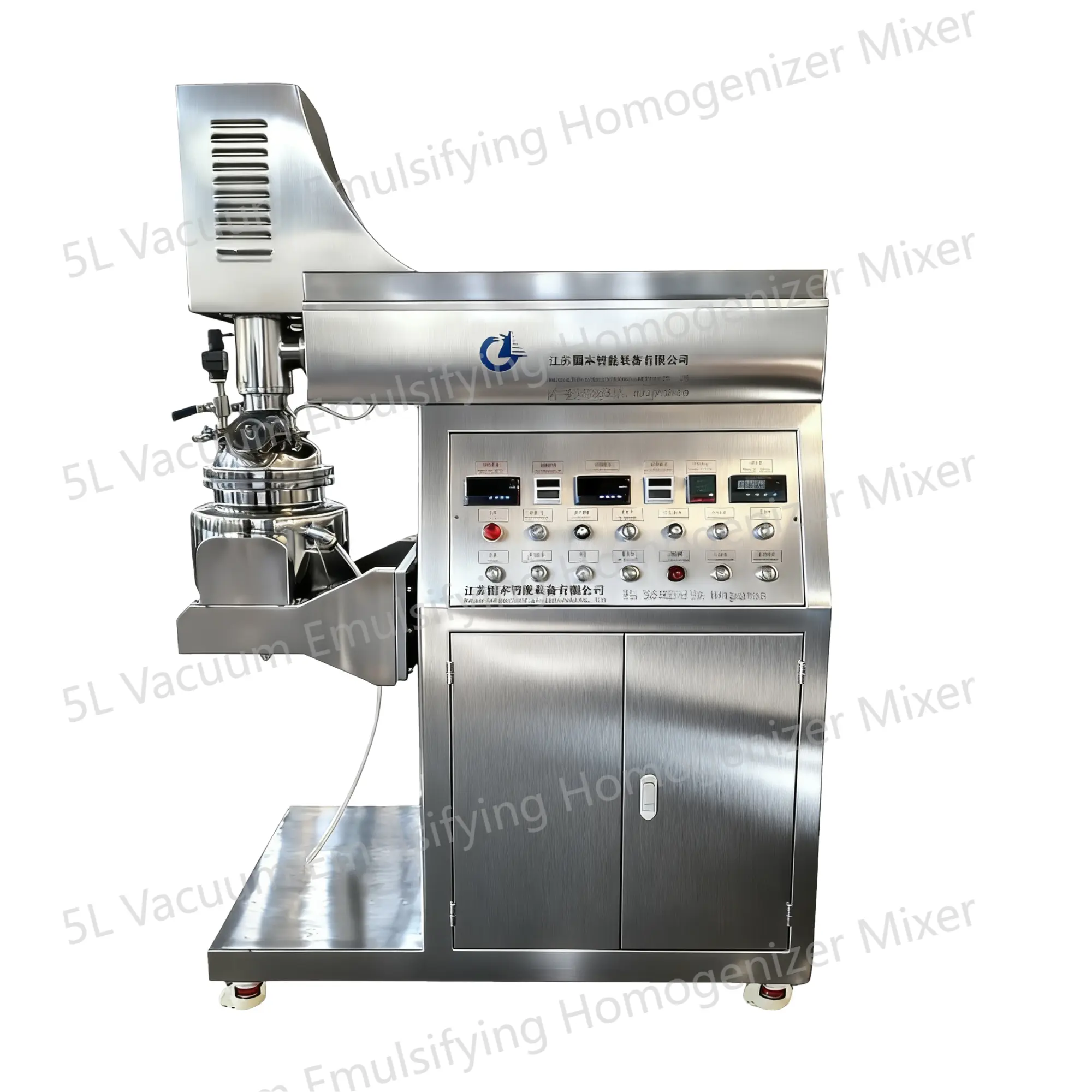 5L Vacuum Emulsifying Homogenizer Mixer
The 5L vacuum emulsifying mixer is a device designed for emulsifying and mixing various substances in a vacuum environment. This equipment is equipped with a mixing tank with a capacity of 5 liters and is widely applied in industries such as food, pharmaceuticals, cosmetics, and pesticides.
-
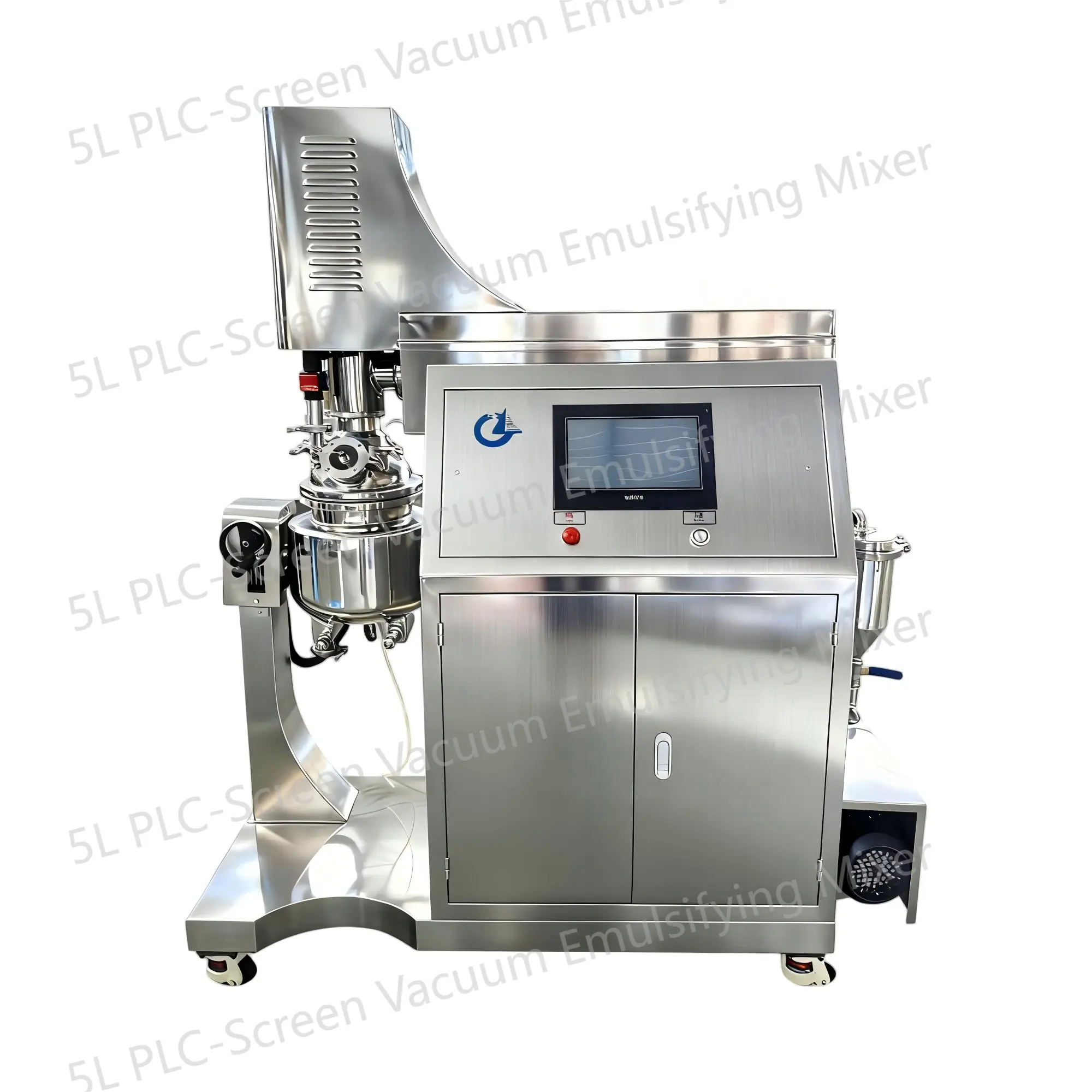 5L PLC-Screen Vacuum Emulsifying Mixer
The 5L PLC-Screen Vacuum Emulsifying Mixer is a device designed for emulsifying and mixing various substances in a vacuum environment. This equipment is equipped with a mixing tank with a capacity of 5 liters and is widely applied in industries such as food, pharmaceuticals, cosmetics, and pesticides.
-
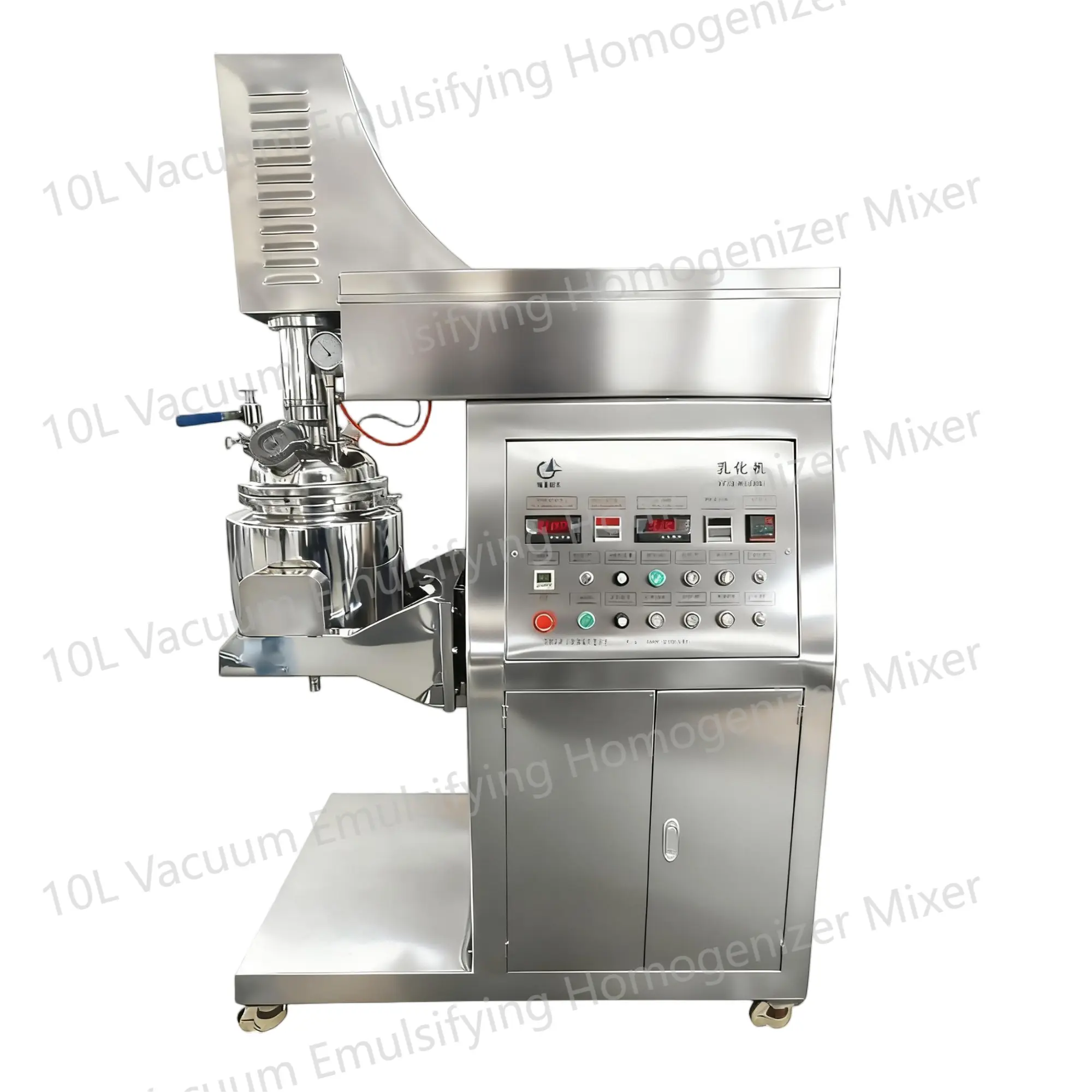 10L Vacuum Emulsifying Homogenizer Mixer
The 10L Vacuum Emulsifying Mixer is a device used for emulsifying and mixing various substances in a vacuum environment. It is commonly used in industries such as food, cosmetics, and pharmaceuticals.